

Self-Aligning Ball Bearings
Overview
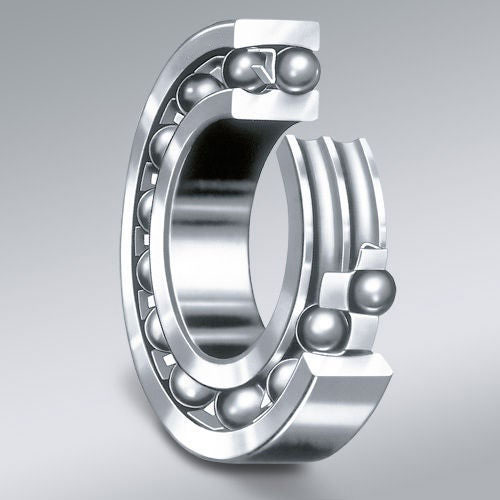
Self-aligning ball bearings are recommended for applications where aligning the shaft and housing is difficult or where the shaft may bend, such as transmission shafts. The outer ring has a spherical raceway and its center of curvature coincides with that of the bearing, allowing the axis of the inner ring, balls, and cage to rotate freely around the bearing center. Pressed steel cages are typically used for this type.
Since they have a small contact angle, self-aligning ball bearings have low axial load capacity. Permissible dynamic misalignment is approximately 0.07 to 0.12 radian (4 to 7 degrees) under normal loads; however, such angles may not be allowable depending on the surrounding structure.
Features
- Correct for misalignment
The inner ring, balls, and cage rotate freely around the bearing center, allowing permissible dynamic misalignment of about 0.07 to 0.12 radian (4 to 7 degrees) under normal loads. - Ideal for difficult mountings
Self-aligning ball bearings suit applications where shaft bending occurs and where it is difficult to align the shaft and housing (transmission shafts, etc.)
Applications
- Gearboxes/speed reducers
FAQs
 Loads are defined by their direction. Loads perpendicular to the shaft are called radial loads and loads parallel to the shaft are called axial (thrust) loads.
While DGBBs can handle axial loads in both directions, single-row angular contact ball bearings can only receive axial load in one direction.
Seals and shields offer additional protection for bearing components and help to improve and maintain lubrication. In terms of sealing performance, sealed bearings rank best, followed by shielded bearings, then finally open bearings. NMT uses supplementary designations D, DU, DW, and V (DD, DDU, DDW, VV) for sealed bearings and Z (ZZ) for shielded bearings. No supplementary designations are listed for open bearings.


